HireVue Portrait Game: How to Prepare and Practice (Complete Guide)
Candidate Falcon
Editorial Team
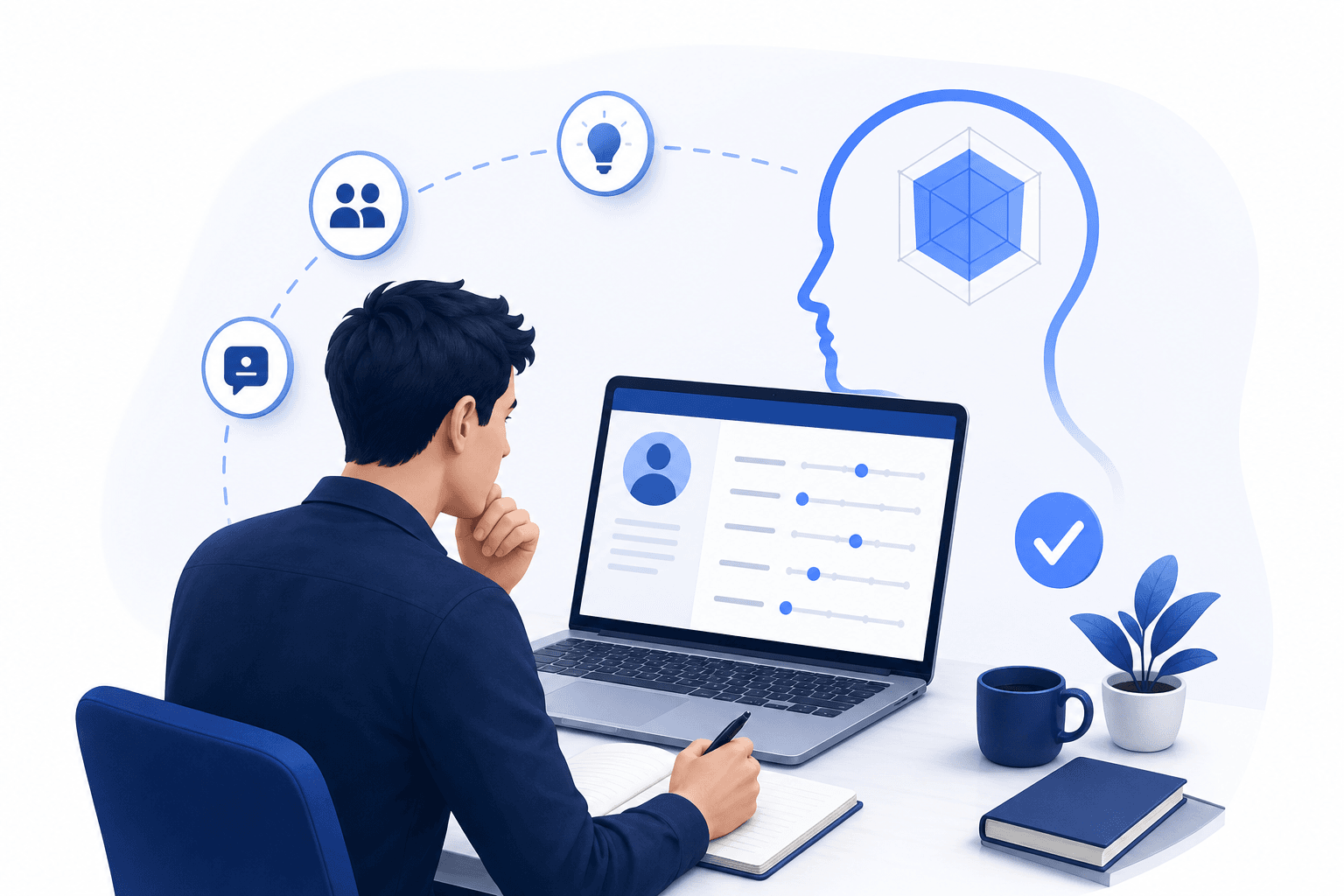
You open your HireVue assessment expecting a cognitive puzzle and instead get a screen asking how well a statement describes you. No millisecond timer. No numbers to memorize. Just a series of behavioral prompts about how you work, communicate, and make decisions.
That's the Portrait game — and it catches a lot of candidates off guard precisely because it feels low-stakes. It isn't. Understanding what Portrait actually measures, and approaching it with some intention, can meaningfully affect how your results are interpreted.
What Is the HireVue Portrait Game?
Portrait is a personality and work-style assessment embedded in HireVue's game-based evaluation suite. Unlike cognitive games such as Digit Span or Flashback, it has nothing to do with memory, processing speed, or numerical reasoning. It measures behavioral tendencies and work-style preferences.
You're typically shown a series of statements and asked how well each one describes you — usually on a scale from "not at all like me" to "very much like me." The statements cover a wide range of workplace behaviors: how you handle ambiguity, whether you prefer working independently or collaboratively, how you respond to feedback, how you approach deadlines, and similar themes.
Some implementations are adaptive, meaning your earlier responses can influence which statements appear later. The whole exercise usually takes between five and fifteen minutes.
Why Employers Use Portrait
Portrait gives hiring teams a structured, consistent view of candidate work styles that a resume simply can't provide. Instead of relying on a recruiter's subjective read of an interview, employers get a behavioral profile that can be compared across all applicants using the same criteria.
Most employers configure Portrait around a specific competency framework tied to the role. A customer-facing position might weight responses related to empathy and communication. A data analyst role might prioritize signals of methodical thinking and attention to detail. The same Portrait assessment can produce different signals depending on what the employer has set it to measure — which is worth keeping in mind as you prepare.
What Portrait Does Not Do
Portrait doesn't measure intelligence, speed, or accuracy. There are no right or wrong answers the way a math question has a right answer. The assessment is designed to surface patterns in how you describe yourself, not to catch you making errors.
That said, it's not a casual survey. The statements are developed by occupational psychologists to detect inconsistency, social desirability bias — the tendency to answer in ways that seem impressive rather than truthful — and response patterns that don't hold up when similar questions are asked in different ways.
Trying to game Portrait by giving the answers you think the employer wants is genuinely risky. The assessment includes internal consistency checks, and a profile that looks artificially polished tends to raise flags rather than impress.
How to Approach Portrait Strategically and Authentically
Strategic preparation here isn't about faking a personality. It's about knowing yourself well enough to answer clearly and consistently, and thinking through how your genuine strengths connect to the role you're applying for.
Research the Role's Core Competencies Before You Start
Before you open the assessment, spend fifteen minutes with the job description. Look for behavioral language: words like "collaborative," "self-directed," "detail-oriented," "resilient under pressure," or "client-focused." These signal what the employer values.
You're not inventing traits you don't have. You're thinking deliberately about which of your real work-style tendencies are most relevant to this role, so those tendencies are front of mind when you respond.
Answer Consistently Across Similar Statements
Portrait often includes multiple statements probing the same underlying trait from slightly different angles. You might see "I prefer to plan my work in advance" early on and "I feel uncomfortable when things are unstructured" later. Both are measuring a similar dimension.
If you rate the first statement highly and the second one low, the assessment flags that inconsistency. It doesn't mean you've failed, but it can reduce the reliability of your profile — which isn't in your interest. Pay attention to what you're actually saying across the full set of responses, not just each statement in isolation.
Don't Overthink Individual Statements
The most common mistake in Portrait is spending too long on each item, analyzing it for hidden meaning. That tends to produce inconsistent answers because you end up second-guessing your initial, honest reaction.
Your first instinct is usually your most accurate one. Read the statement, recognize whether it genuinely describes you, and respond. Portrait is designed to capture your natural behavioral patterns, and overthinking disrupts that signal.
Be Honest About Moderate Responses
Not every statement needs a strong rating in either direction. If something is somewhat true of you, a moderate rating is the accurate answer. Candidates sometimes feel pressure to give extreme responses because they seem more decisive — but a profile made up entirely of extreme ratings can look unreliable. If you genuinely sit in the middle on something, say so.
Common Mistakes in the Portrait Game
Trying to match an imagined "ideal" profile. Employers configure Portrait to match specific role requirements. You don't know exactly what they've weighted, and attempting to optimize for a profile you can't see usually backfires.
Inconsistency across similar questions. Portrait includes internal checks. Varying your answers significantly on closely related statements undermines your profile's credibility.
Rushing through without reading carefully. Some statements require a moment of attention. "I rarely feel overwhelmed by competing priorities" is a different statement from "I feel energized by competing priorities." Misreading leads to answers that don't reflect you accurately.
Treating Portrait as less important than the cognitive games. Because there's no obvious score to optimize, candidates sometimes approach it casually. Employers weight it seriously as part of the overall HireVue profile.
Portrait Prep Checklist
Before you begin the assessment:
- Review the job description and note the behavioral competencies the role emphasizes
- Reflect on two or three genuine work-style strengths you want to come through clearly
- Set aside enough uninterrupted time — fifteen to twenty minutes is usually sufficient
- Find a quiet environment where you can focus
- Commit to answering based on how you actually work, not how you think you should work
- Read each statement carefully before responding
- Trust your first instinct rather than over-analyzing
Practicing for Portrait With Candidate Falcon
Candidate Falcon includes a Portrait practice simulation as part of its HireVue preparation suite. The simulation reproduces the format and pacing of the real assessment, so you can experience what it feels like to move through a full set of behavioral statements under realistic conditions.
Practicing beforehand helps in two ways. First, you get familiar with the statement format and rating scale, so nothing feels unfamiliar when it counts. Second, you can review your practice responses and check for consistency patterns before you sit the actual game.
Candidate Falcon covers all 11 HireVue game types — including Portrait — alongside dedicated video interview preparation with AI-powered feedback on recorded responses and unlimited practice recordings. If your HireVue invitation includes both games and a video interview component, you can prepare for the full assessment in one place.
Visit Candidate Falcon to start preparing now.
Conclusion
Portrait rewards self-awareness and consistency, not performance. The candidates who do best are those who've taken a few minutes to think about their genuine work-style tendencies, understand what the role requires, and then answer honestly and deliberately throughout. There's nothing to memorize here. It comes down to knowing yourself clearly enough to represent yourself accurately when it matters.
Frequently Asked Questions
What does the HireVue Portrait game measure? Portrait measures behavioral tendencies and work-style preferences — things like how you handle ambiguity, collaborate with others, and respond to feedback. It's a personality-style assessment, not a cognitive test. There are no correct or incorrect answers.
Can you fail the HireVue Portrait game? Not in the traditional sense. Portrait doesn't have right or wrong answers. However, highly inconsistent responses or a profile that appears artificially optimized can reduce the reliability of your results, which employers may interpret negatively.
How long does the HireVue Portrait game take? Most candidates complete Portrait in five to fifteen minutes. The exact length depends on the employer's configuration and whether the assessment is adaptive.
Should I answer Portrait questions based on the job description? You shouldn't fabricate traits to match the job description. That said, it's worth reflecting on your genuine strengths before you start, so the work-style qualities most relevant to the role are front of mind as you respond.
Why does Portrait ask similar questions multiple times? Portrait includes overlapping statements to check for internal consistency. It's a deliberate design feature that helps the assessment detect whether your responses reflect stable behavioral patterns or whether you're varying your answers without a clear basis.
Is Portrait part of every HireVue assessment? No. Employers choose which games and components to include. Portrait appears in some HireVue assessments but not all. Check your invitation materials or ask your recruiter if you're unsure what your specific assessment includes.
How can I practice for the HireVue Portrait game? Candidate Falcon offers a Portrait practice simulation that reproduces the real assessment format, alongside preparation modules for all 11 HireVue game types and video interview practice with AI-powered feedback. You can access it at candidatefalcon.com.