ShapeDance Practice: The Most Effective Way to Build Speed and Accuracy
Candidate Falcon
Editorial Team
If you've just received a HireVue assessment invitation and spotted ShapeDance on the list, you're probably wondering what it actually tests and how to get faster at it before the deadline hits. This article covers exactly how ShapeDance works, what the scoring logic rewards, and how to structure your practice so you're building real speed and accuracy rather than just going through the motions.
What ShapeDance Actually Measures
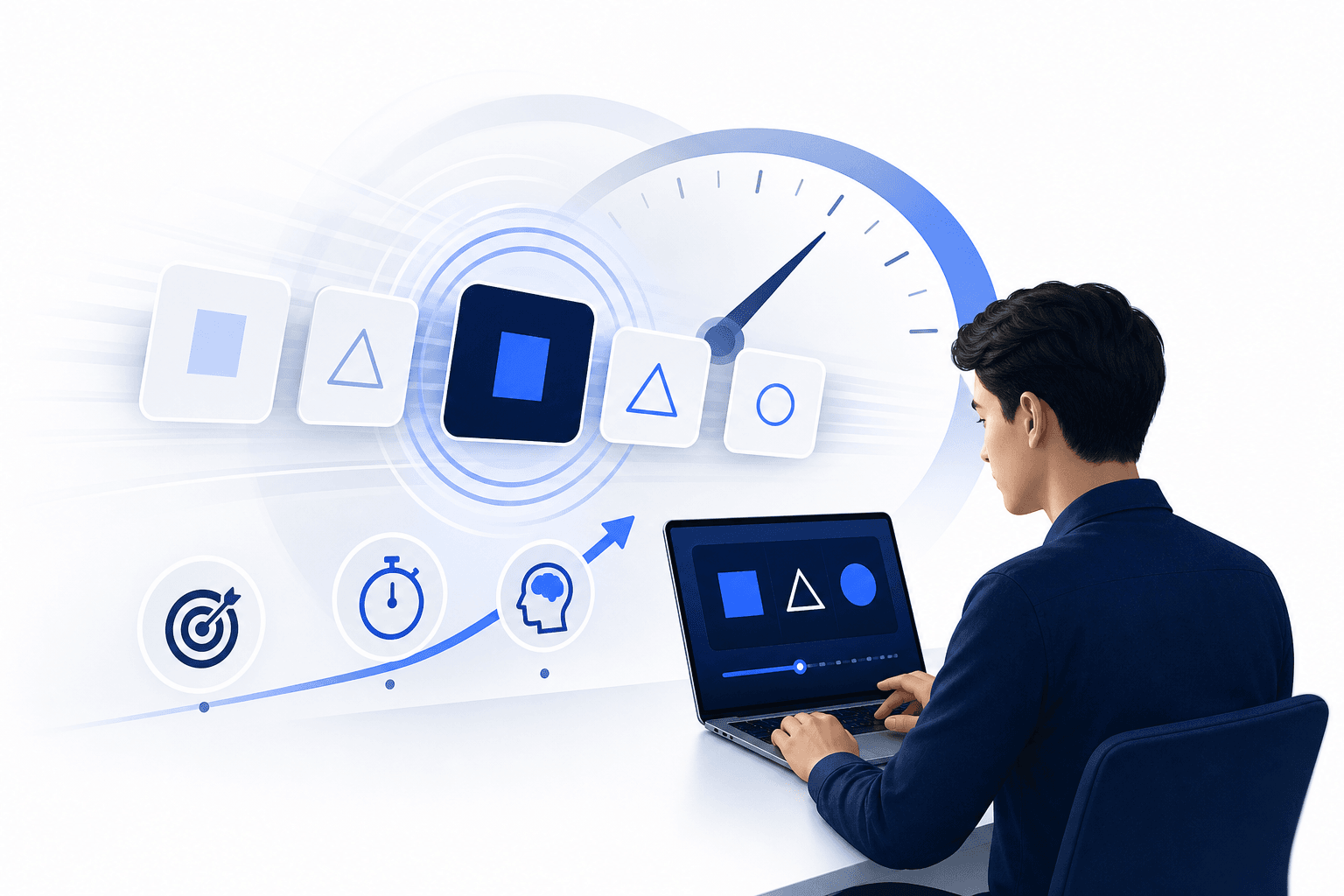
ShapeDance is one of the 11 HireVue game-based assessments, sitting in the cognitive-behavioral category. The game presents shapes on screen and asks you to make rapid decisions based on rules that change or compound as the game progresses. The core cognitive demand is dual-task processing: holding a rule in working memory while simultaneously executing a motor response under time pressure.
HireVue isn't measuring your shape knowledge. It's measuring how quickly your brain can switch between competing rules, how accurately you execute under speed pressure, and how your performance holds up as cognitive load increases. Those signals map to traits like adaptability, attention to detail, and processing efficiency.
This distinction matters for how you practice. Training only for speed without maintaining accuracy means optimizing for the wrong outcome. The scoring rewards the combination of both.
Why Random Practice Doesn't Work
Most candidates who try to prepare for ShapeDance do one of two things: they read about it and feel ready, or they play it once or twice and assume familiarity equals preparation. Neither approach builds the automaticity you actually need.
The game's difficulty comes from rule-switching under pressure. When you first encounter a new rule combination, your brain processes it consciously and slowly. That's manageable in the early rounds. But as the game accelerates, conscious processing can't keep up. What you need is pattern recognition that fires fast enough to match the game's pace.
That only comes from repeated, structured exposure to the specific stimulus-response patterns ShapeDance uses. Reading about the format gives you zero of that. Playing it once or twice gives you awareness, not fluency.
How to Structure Effective ShapeDance Practice
Start With Rule Clarity Before Speed
Before you try to go fast, you need to know the rules cold. In your first few practice sessions, slow down deliberately. Work through each rule combination until your response is automatic at a comfortable pace. Any hesitation you have now will compound badly once the game speeds up.
Write the rules down if it helps. Say them out loud. The goal in this phase is zero ambiguity about what each shape-rule combination requires.
Build Speed in Layers
Once your accuracy at a slow pace is consistent, start pushing the pace in increments. Don't jump straight to maximum speed. Your brain needs to consolidate each pattern at one speed level before it can reliably perform at the next.
A practical structure: three sessions at comfortable pace, two at moderate pace, two at near-real assessment pace. By the time you're doing full-speed runs, the decisions should feel close to automatic.
Use Timed Blocks, Not Marathon Sessions
Cognitive fatigue hits fast in games like ShapeDance. A 45-minute session where your focus degrades after 20 minutes is less useful than two focused 20-minute blocks with a break in between. Short, high-intensity practice with genuine rest between blocks produces better gains than grinding through fatigue.
Set a timer. When it goes off, stop. Review what happened in that block before you start the next one.
Track Accuracy Separately From Speed
After each session, note two things: your speed (how far you got, how many rounds you completed) and your accuracy (how many errors you made and when they appeared). Most people only pay attention to speed, but accuracy errors carry real information.
Errors that cluster at the start of a session point to a warm-up problem. Errors that cluster at the end suggest fatigue or attention issues. Errors that appear consistently on one specific rule combination mean you have an unresolved ambiguity in your rule processing. Each of these has a different fix.
Simulate Real Conditions
Practicing ShapeDance in a relaxed environment at home is not the same experience as completing it inside a live HireVue assessment with a job on the line. Pressure changes your cognitive state, and your cognitive state affects your performance.
To close that gap, practice under conditions that feel slightly uncomfortable. Use a visible countdown timer. Sit in the same physical position you'll use for the real assessment. Remove distractions. Make the session feel like something that matters. The goal is to make the real assessment feel familiar rather than novel.
Your device setup matters here too. A lagging browser or a small screen adds unnecessary friction. Before your assessment, it's worth reviewing best setup tips for HireVue game-based assessments to make sure your hardware and connection aren't working against you.
ShapeDance vs. Other Rule-Switching Games
If you've been asked to complete other HireVue games that involve rule-switching, the preparation principles overlap but the specific mechanics differ. The HireVue Switch Challenge is a related format worth understanding separately, because the rule structures and timing patterns are distinct enough that cross-training without knowing the differences can create confusion rather than fluency.
Treat each game as its own preparation target. The cognitive skills transfer to some degree, but the specific stimulus-response patterns don't.
How Many Practice Sessions Do You Actually Need?
This depends on your starting point, but a realistic estimate for most candidates is six to ten focused sessions spread across two to three days. Here's a rough breakdown:
Sessions 1 to 2: Rule learning at slow pace, focus on zero errors. Sessions 3 to 4: Moderate pace, start tracking accuracy patterns. Sessions 5 to 6: Near-assessment pace, simulate real conditions. Sessions 7 to 10 (if time allows): Full-speed runs with post-session review.
If you only have 24 hours, compress this. Four focused sessions with proper rest between them will do more than eight sessions crammed into a single afternoon.
Where to Practice ShapeDance Specifically
Generic cognitive games won't prepare you for ShapeDance because they don't reproduce the specific interface, timing, and rule structure of the HireVue format. You need a simulation close enough to the real thing that your brain is building the right patterns.
Candidate Falcon covers all 11 HireVue game types, including ShapeDance, with realistic simulations designed to reproduce the actual timing and pressure of the assessment. Each game comes with a dedicated strategy guide, so you're not just practicing blind. The platform runs in a browser with no software to install, which matters when you're working against a 48-hour deadline.
If your HireVue assessment includes other games beyond ShapeDance, you can prepare for all of them in one place without switching between platforms. Visit candidatefalcon.com/pricing to see current plan options.
The Accuracy-Speed Trade-Off in Practice
Speed built on top of shaky accuracy just produces fast errors. Speed built on top of solid accuracy produces the combination the scoring actually rewards. Every session where you sacrifice accuracy to go faster is a session where you're reinforcing the wrong pattern.
Get accurate first. Speed follows naturally as the patterns become automatic. Trying to force both simultaneously in early practice is the most common mistake candidates make with ShapeDance. It feels counterintuitive when the game is visibly timed, but the sequence matters.
Frequently Asked Questions
What does ShapeDance measure in a HireVue assessment? ShapeDance measures cognitive processing speed, working memory, and the ability to switch between rules under time pressure. These signals are used to assess traits like adaptability and attention to detail, not knowledge of shapes or patterns.
How long does it take to prepare for ShapeDance? Most candidates benefit from six to ten focused practice sessions spread over two to three days. If you have only 24 hours, four high-quality sessions with rest between them will produce better results than one long session.
Should I prioritize speed or accuracy when practicing ShapeDance? Accuracy first, always. Speed built on top of accurate pattern recognition is sustainable. Speed built on top of errors just produces faster mistakes. Accuracy becomes automatic with enough practice, and speed follows from that.
Can I practice ShapeDance on my phone? It's possible to complete HireVue assessments on mobile, but a desktop or laptop browser typically gives you a more stable experience for game-based assessments. Screen size and input precision both affect performance in games like ShapeDance.
Is ShapeDance the same as other HireVue rule-switching games? No. While some HireVue games share cognitive demands like rule-switching, each game has its own interface, timing, and stimulus-response patterns. ShapeDance preparation does not substitute for preparation on other games like the Switch Challenge.
How realistic do practice simulations need to be? As close to the real thing as possible. The goal of practice is to make the real assessment feel familiar. If your practice environment differs significantly from the actual HireVue interface and timing, the familiarity you build won't transfer fully.
Where can I find ShapeDance-specific practice? Candidate Falcon at candidatefalcon.com includes a dedicated ShapeDance simulation alongside preparation for all 11 HireVue game types. The platform is browser-based and includes game-specific strategy guides alongside each simulation.
Reading about ShapeDance gives you a framework. Practicing it builds the speed and accuracy that actually move you through the screening round. Start preparing at candidatefalcon.com.