Numerosity Game Practice: Timed HireVue Simulation
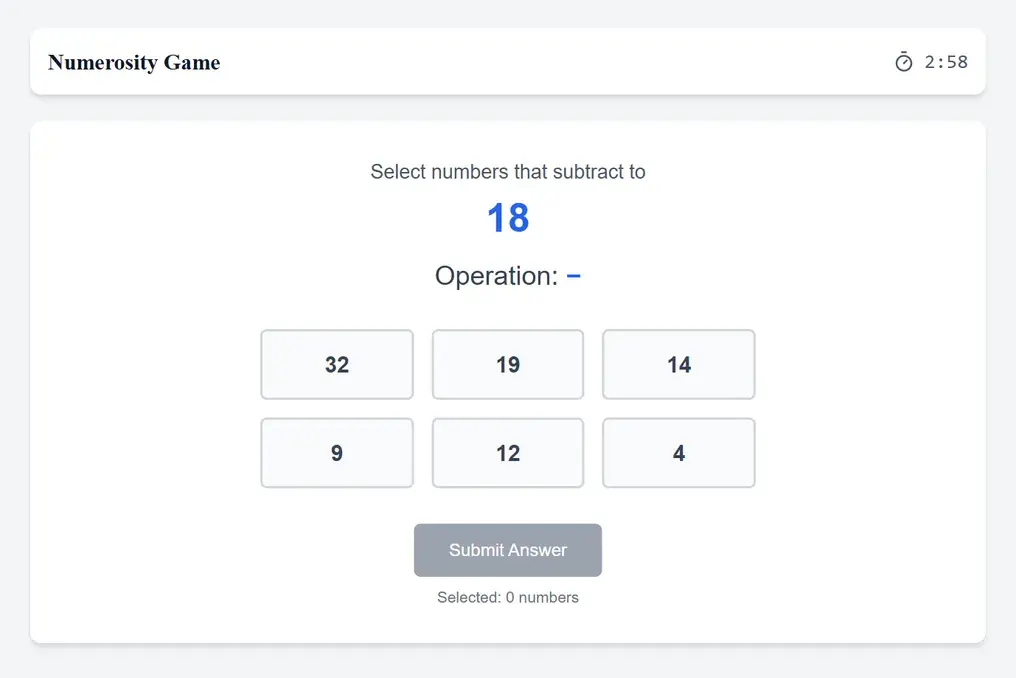
Practice the HireVue Numerosity game in a timed simulation: pick the numbers that hit the target with +, −, × or ÷, then review your correct and wrong answers.
How to Play
An operation symbol (+, -, x, ÷) appears at the start of each question.
Select the numbers that correctly satisfy the target condition.
Balance speed and accuracy to maximize your score.
Skills Assessed
- Task
- Select numbers that produce a target with the displayed operation
- Operations
- Addition, subtraction, multiplication and division
- Practice timer
- 3 minutes (the studied HireVue version also ran 3 minutes)
- Skills
- Mental arithmetic, speed and accuracy under time pressure
What the Numerosity Game Tests
Numerosity is a target-number mental arithmetic game. Each round shows a target, an operation and a set of numbers, and you select the numbers that produce the target. It rewards fast, reliable arithmetic facts rather than advanced maths.
In the peer-reviewed study of HireVue’s games, Numerosity progress was measured with several gameplay features, including final level, levels lost and win ratio. Speed and accuracy both mattered, so practise answering quickly without letting your error count climb.
How the Numerosity Practice Game Works
- Each round shows six number tiles, a target and an operation: +, −, × or ÷. The operation can change from one round to the next.
- Select the tiles that produce the target. Addition rounds can need two or three numbers; subtraction and division use the larger number first.
- Press Submit Answer. A correct answer counts toward your score, a wrong one is recorded, and a new round starts straight away.
- Keep going until the 3-minute practice timer ends, then review your correct and wrong totals.
Tips to Score Higher in Numerosity
- Name the operation before you look at the numbers. Reading the symbol first prevents the most common rule error.
- For addition, find the largest useful number and search for its complement instead of testing every pair.
- For subtraction, look for two numbers separated by the target; for division, look for one number that is the target times another.
- For multiplication, recall the target’s factor pairs (36 is 4 × 9 or 6 × 6) and look for them directly.
- If a round stalls, make your best deliberate choice and move on; one slow round costs several faster ones.
Common Numerosity Mistakes
- Adding the numbers on a subtraction or multiplication round because the previous round was addition.
- Picking two numbers that fit when the round needed three for the sum.
- Rushing selections so that a known calculation turns into a wrong answer.
- Practising untimed and then being surprised by the pace of a real run.
What Our Numerosity Practice Data Shows
We looked at every completed 3-minute Numerosity run in the Candidate Falcon simulation between 2 May and 16 November 2026: 313 runs by 64 candidates. Unfinished runs and our own test accounts are excluded. Scores are correct answers in our simulation, not HireVue scores.
- The typical first run scored 18 correct answers. The typical second run scored 23, and the typical third run 25.
- Compared with their own first run, candidates scored a median 24% higher on their second run (45 candidates; 60% improved) and 34% higher on their third (30 candidates; 77% improved).
- After the third run the typical score levelled off: among the 20 candidates who played five or more runs, the fifth run was a median 18% above the first, and 55% had improved.
- Wrong answers stayed low throughout, at a median of one or two per run, so the extra correct answers did not come at the cost of more errors.
Two or three full runs captured most of the improvement we measured. Use them to learn the controls and the pace, then spend extra time on the operation that causes most of your wrong answers.
Same-candidate figures compare each candidate’s later run with their own first completed run and report the median. Candidates who keep practising may differ from those who stop, and a practice simulation cannot predict your result in a live assessment.
Full run-by-run table and limits: Numerosity practice data: full figures, sample and method
A Short Numerosity Practice Routine
After the run, use the displayed correct and wrong totals to check accuracy. Compare those totals with how many rounds you played. You can also reflect on whether slow calculation or a rushed selection caused an error; the result does not identify that cause for you.
- Do one run focused only on reading the operation first.
- Write down which operation produced most of your wrong answers.
- Drill that operation’s facts for five minutes.
- Do a second run and compare correct and wrong totals with the first.
Numerosity Practice FAQ
Is this the real HireVue Numerosity game?
No. Candidate Falcon is independent and not affiliated with HireVue. This simulation reproduces the documented task—hit a target with the displayed operation under a timer—so you can practise the format before your assessment.
How long is the Numerosity game?
The peer-reviewed study of HireVue’s games describes a three-minute version, and this practice simulation also runs for three minutes. The on-screen timer in your own assessment is the authority for your version.
Can I practise Numerosity for free?
This page and the full Numerosity guide are free to read, no account needed. Playing the timed simulation requires a games plan that includes HireVue, or Full Access.
How many times can I play the practice game?
As many times as you like while your plan is active. Every run is saved, so you can compare your correct and wrong totals across attempts.
What is a good Numerosity score?
No verified public score or level guarantees progression in a live assessment. In our simulation, the typical first run scores 18 correct answers in three minutes and the typical third run 25; these are practice figures, not HireVue thresholds. Aim for more correct answers per run while keeping wrong answers low; the Numerosity guide explains what the published research does and does not show.
Practice Other HireVue Games
This is an independent Candidate Falcon simulation. Its three-minute timer is a practice setting, not a statement about every HireVue assessment. Start a run when you can focus on both calculation and selection. You can repeat the simulation after you review your result. Candidate Falcon is not affiliated with HireVue. For the rules, research evidence and detailed strategy, read the full Numerosity guide.